
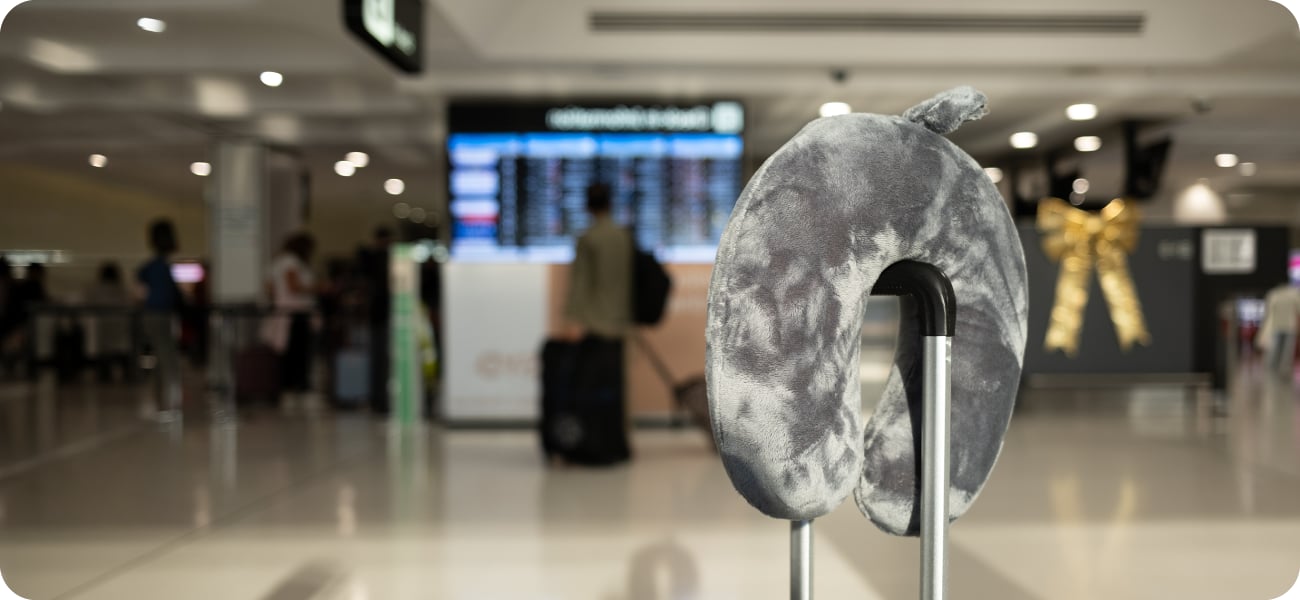
To see just how much a travel pillow collects on a normal trip, we swabbed one after it touched five common airport and airplane surfaces, then measured the bacteria in colony-forming units (CFUs). We also surveyed 1,013 Americans about where they set down their travel pillows and how often they clean them. The results trace the full germ journey of a travel pillow, from curb to cabin, and show how rarely travelers do anything about it.
Key Takeaways
- Baggage claim left the travel pillow with the most bacteria of all the surfaces tested (24.8 million CFUs).
- A travel pillow left at baggage claim had over 48,000x the bacteria of a toilet seat.
- A travel pillow left on an airplane tray table had over 6.5x as many bacteria as a toilet seat.
- More than half of travelers (52%) put their pillow back on their face without cleaning it after it touched shared surfaces.
- 2 in 5 travelers (40%) let their pillow touch 3 or more shared surfaces during a trip.
- Over 1 in 5 travelers (21%) have never washed their travel pillow.
- Over 1 in 4 travelers (26%) wipe down the airplane tray table but not their travel pillow.
Where a Travel Pillow Picks Up the Most Germs
We placed one pillow on five surfaces a traveler meets on a typical trip, then sent each swab to the lab to count the bacteria.
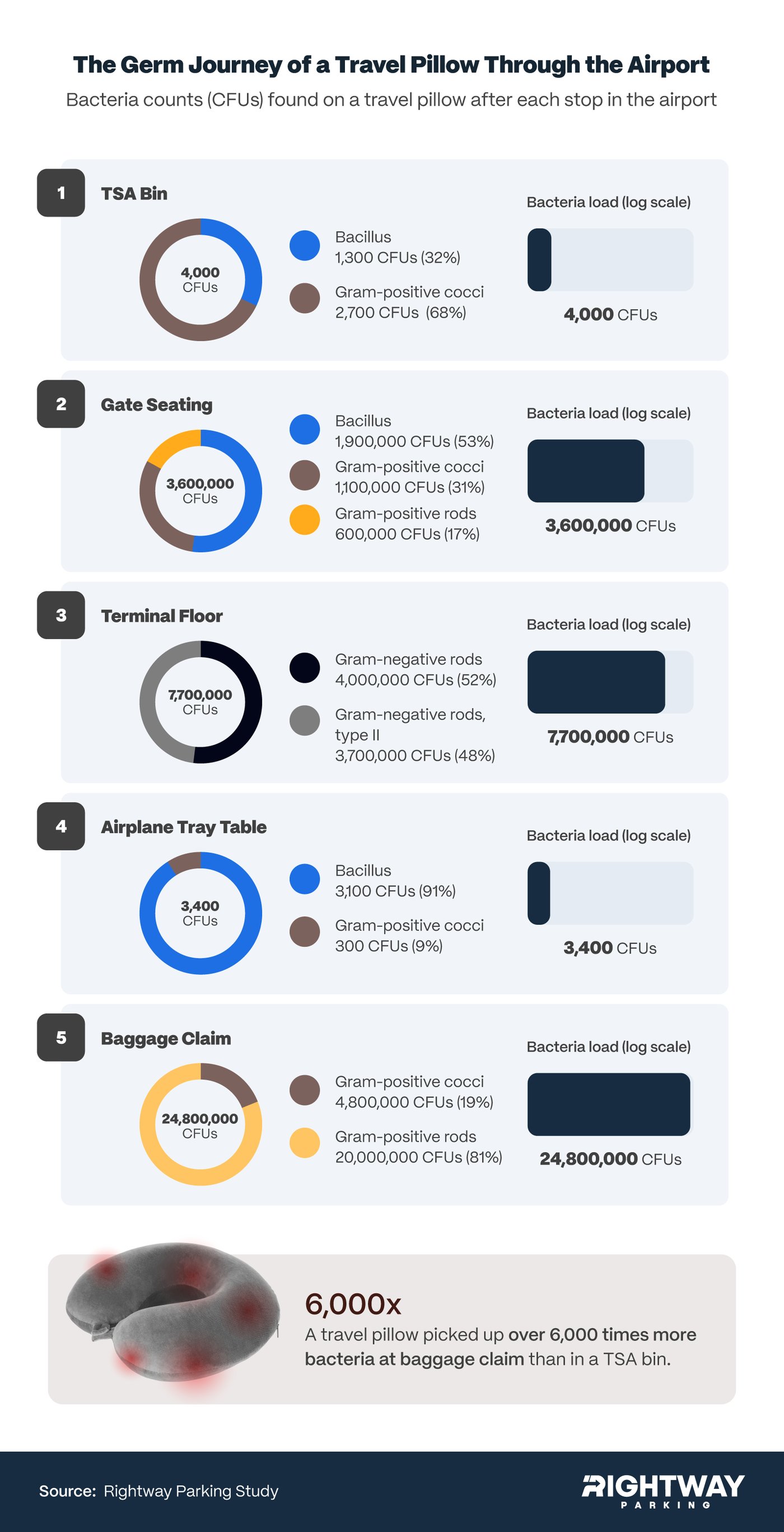
The dirtiest moment came at the very end. Baggage claim left the pillow with 24.8 million CFUs, the most of any surface we tested, and over 6,000 times the bacteria it picked up in a TSA bin. The terminal floor was next at 7.7 million CFUs, more than double the 3.6 million found after gate seating. These three stops — baggage claim, the terminal floor, and gate seating — accounted for over 99.9% of all bacteria collected across the five tests.
The type of bacteria mattered as much as the count. The terminal floor was the only surface that transferred Gram-negative rods to the pillow, including a type II group associated with hospital-acquired infections and antibiotic resistance.
Bacillus, a bacterium found in soil, turned up on three surfaces: TSA bins, gate seating, and airplane tray tables. The cleanest spot might surprise you. It's the airplane tray table, which left the pillow with just 3,400 CFUs, the lowest reading in the study.
How a Travel Pillow Stacks Up Against Things You Already Avoid
To put those counts in context, we compared the pillow after each surface to everyday items people consider dirty.
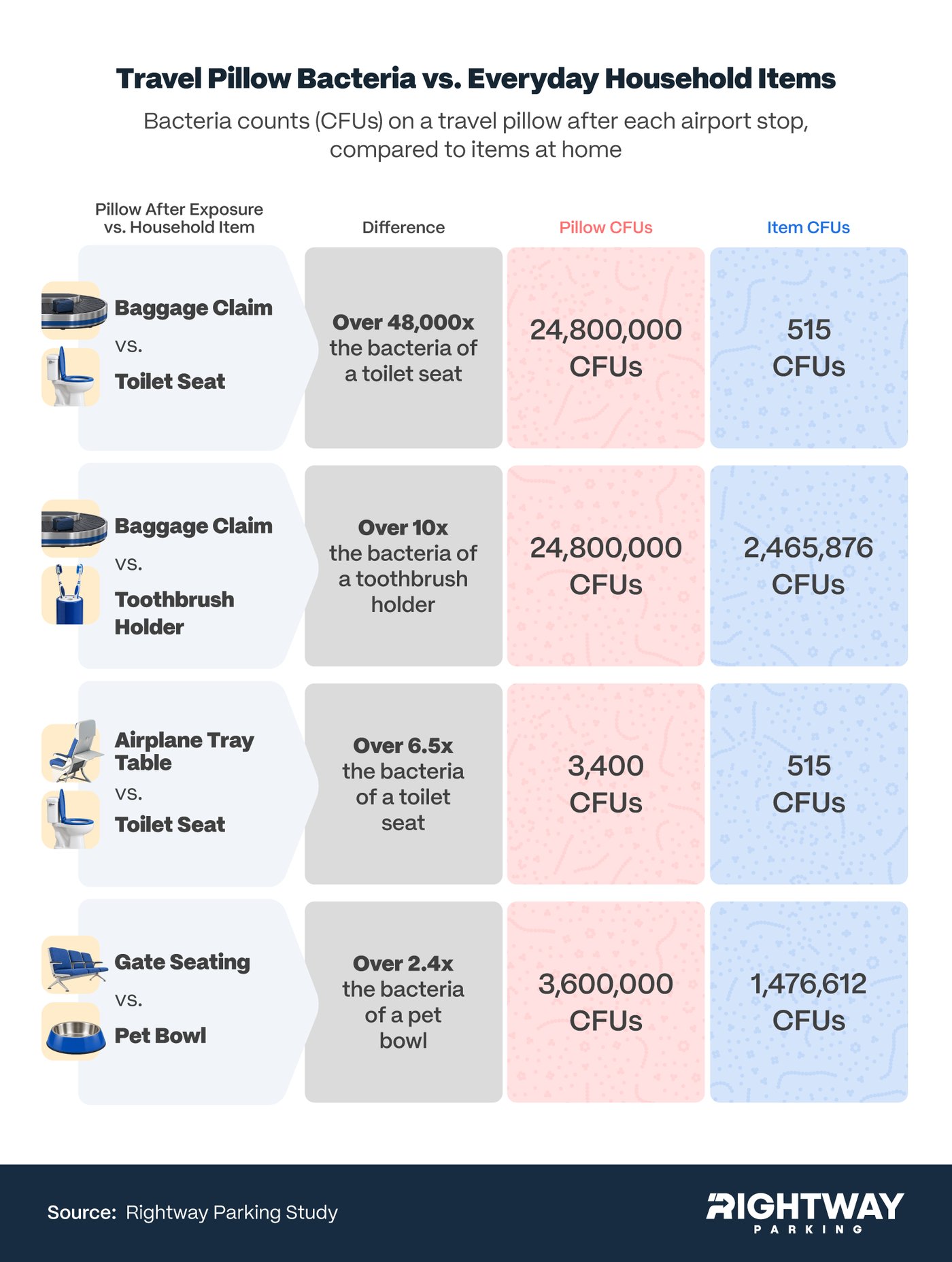
After a stop at baggage claim, the travel pillow carried over 48,000 times the bacteria of a toilet seat and more than 10 times that of a toothbrush holder. A pillow left in gate seating held over 2.4 times the bacteria of a pet bowl.
And a pillow resting on an airplane tray table, the lowest-bacteria surface we measured, still carried over 6.5 times as many bacteria as a toilet seat.
The Path a Pillow Takes From Curb to Cabin
Lab counts show what a pillow can pick up, so we asked travelers where theirs actually goes and what they do with it next.
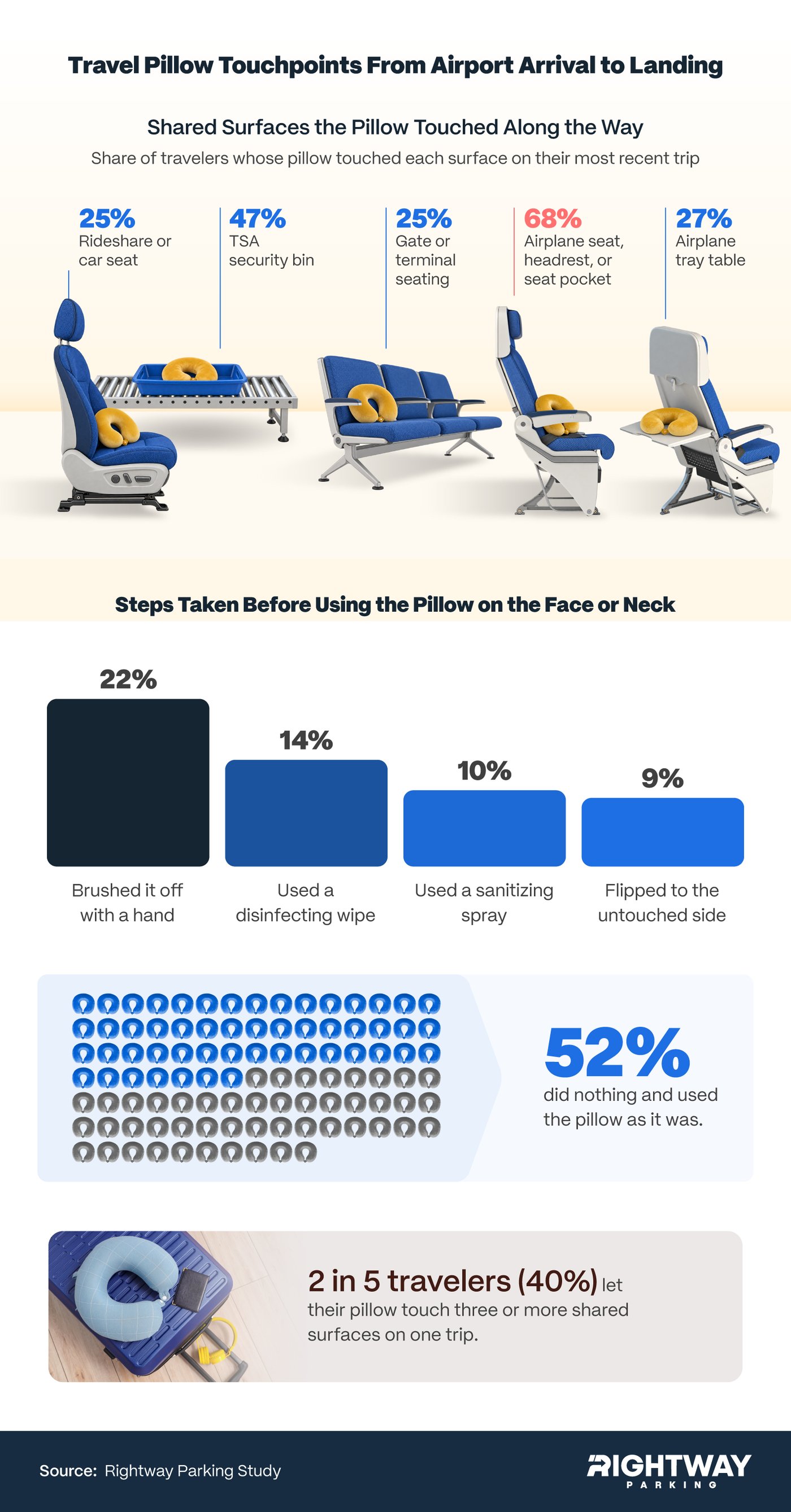
A pillow rarely touches just one thing: 40% of travelers let theirs touch three or more shared surfaces on a single trip. Nearly half (47%) ran it through a TSA security bin, including 50% of millennials, 48% of Gen Z, 43% of Gen X, and 35% of baby boomers. The pillow reached the baggage claim area for 15% of travelers, and nearly half of them (49%) did nothing to it afterward.
What happens after contact is the bigger issue. More than half of travelers (52%) put the pillow straight back on their face without cleaning it, a habit most common among baby boomers (62%), followed by millennials (53%), Gen X (50%), and Gen Z (46%).
Nearly 1 in 10 (9%) did not even realize their pillow had touched anything, while just over 1 in 10 (12%) kept it in a bag or around their neck the whole trip, so it touched nothing.
How Often Travelers Clean Their Pillows
If a pillow collects this much on one trip, how it gets cleaned between trips matters, so we asked.
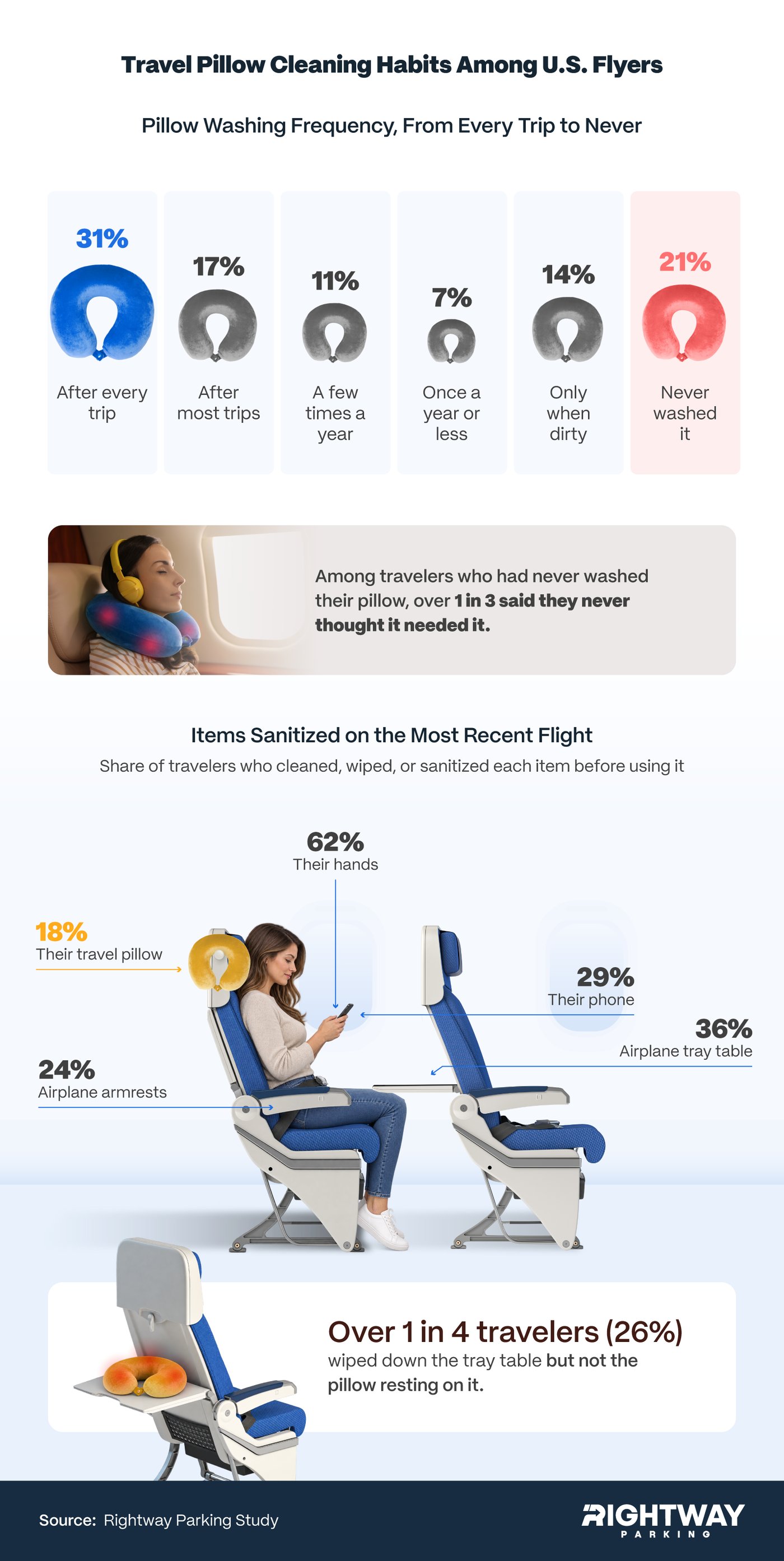
Over 1 in 5 (21%) have never washed their travel pillow, with baby boomers (33%) leading, followed by Gen Z (26%), millennials (20%), and Gen X (17%). A cover doesn't close the gap, either. Nearly 1 in 5 travelers (18%) had a removable cover but rarely or never washed it, and another 29% had no cover.
Frequent flyers were not any better here, as those taking 6 to 10 flights a year were the most likely to have a cover they rarely wash (28%), compared to 13% of those taking just 1 or 2 flights.
When travelers do clean on the go, the pillow is last in line. Just over 1 in 3 (36%) wiped down their airplane tray table, yet only 18% wiped the pillow that rested on it, leaving over 1 in 4 travelers (26%) cleaning the table but not the pillow against their face.
On the most recent flight, 62% sanitized their hands and 29% their phone, while just 18% gave the pillow the same treatment. The most common reasons for skipping it were:
- Only using it a few times a year (32%)
- Forgetting about it once home (27%)
- Worrying that washing would ruin it (17%)
Among those who had never washed their pillow, over 1 in 3 (34%) said they never thought it needed to be washed.
Cleaner Gear Before Takeoff
A travel pillow collects bacteria throughout a trip, and swab counts show that the last stops are often the dirtiest. The fix is small. Keep the pillow in a bag or on your neck instead of on the floor or in the bin, give it a wipe when you clean your hands or the tray table, and run the cover through the wash after a trip. A little attention before takeoff keeps the one piece of gear meant for rest from carrying airport germs home with you.
Methodology
Rightway Parking collected surface samples for this study; each surface was swabbed three times, and the CFUs per swab were averaged for each surface type. A lab conducted Gram stain and culture swab tests across the travel pillows. Bacteria counts for the comparisons were sourced from the NSF International 2011 Household Germ Study . It’s possible that we could have gained further insight into CFU levels with a larger sample size of surfaces. The above claims are based solely on means, as no statistical testing was performed; therefore, this content is exploratory. Bacteria definitions were sourced from the National Center for Biotechnology Information ( NCBI ) and Britannica .
Additionally, we surveyed 1,013 Americans recruited through Connect Cloud Research regarding their travel pillow habits. The mean age of respondents was 40 years old. Among them, 56% were female, 42% were male, and 2% were non-binary or preferred not to say. Respondents comprised the following generational breakdown: 22% Gen Z, 50% millennials, 22% Gen X, and 6% baby boomers.
About Rightway Parking
Rightway Parking is a reservation platform that helps travelers book guaranteed parking in advance at airports, cruise ports, and event venues across more than 1,000 locations in the U.S. and Canada. Working with vetted operators and national hotel brands, it offers secure spots near terminals with shuttle, valet, and self-park options, flexible cancellations, and 24/7 U.S.-based support, so the trip starts and ends without the guesswork.
Fair Use Statement
Feel free to share these findings for any noncommercial purpose. We only ask that you link back to this page so readers can see the full study and that the research is credited to its authors.