
Getting to the airport is supposed to be the easy part. But at some of the country's busiest hubs, just reaching the gate can eat up nearly an hour, and that's before delays or cancellations even enter the picture.
Rightway Parking analyzed 55 major airports in the U.S. across five factors: delay rate, cancellation rate, how much delays have worsened since 2021, and how far (and how long) it takes to get there from downtown, to rank the most and least stressful airports to fly through.
Key Takeaways
- Dallas/Fort Worth International Airport (DFW), O'Hare International Airport (ORD), and Ronald Reagan Washington National Airport (DCA) rank as the most stressful airports in the U.S.
- Salt Lake City International Airport (SLC) ranks as the least stressful airport in the U.S.
- Dallas/Fort Worth International Airport (27.86%), West Palm Beach International Airport (26.00%), and Denver International Airport (25.40%) rank as the airports with the most flight delays in the U.S.
- Ronald Reagan Washington National Airport (3.86%), LaGuardia Airport (3.04%), and Dallas/Fort Worth International Airport (2.76%) rank as the airports with the most canceled departures in the U.S.
Which Airports Rank as the Most Stressful Overall?
When cancellation rates, delays, worsening delay trends, and distance from downtown are combined into one stress score, Dallas/Fort Worth International (DFW) ranks as the most stressful airport in the study, followed by O'Hare International (ORD) and Ronald Reagan Washington National (DCA).
The most stressful airports rarely perform poorly in just one area. Travelers are more likely to face multiple frustrations, from getting to the airport to waiting out a delayed or canceled flight:
- DFW pairs a 27.86% delay rate with a 33.67% increase in delays, while also sitting 22 miles from downtown.
- O'Hare has a slightly lower delay rate at 24.68%, but delays have climbed 42.77%, and the trip from downtown takes about 50 minutes.
- Reagan National is much closer to the city, but that convenience comes with another problem: it has the highest cancellation rate among the top three, at 3.86%, and its delay rate has jumped 73.92%.
At the opposite end of the ranking, Salt Lake City International (SLC) is the least stressful airport in the study, followed by San Jose International (SJC) and Honolulu Daniel K. Inouye International (HNL). All three have cancellation rates below 1%, relatively short trips from downtown, and lower delay rates than many of the airports near the top of the list.
They may not guarantee a perfectly smooth travel day, but compared with the highest-stress airports, the odds are much more in travelers' favor.
Where Delays, Cancellations, and Long Drives Hit Hardest
The overall ranking shows which airports are toughest on travelers, but the individual metrics reveal why.
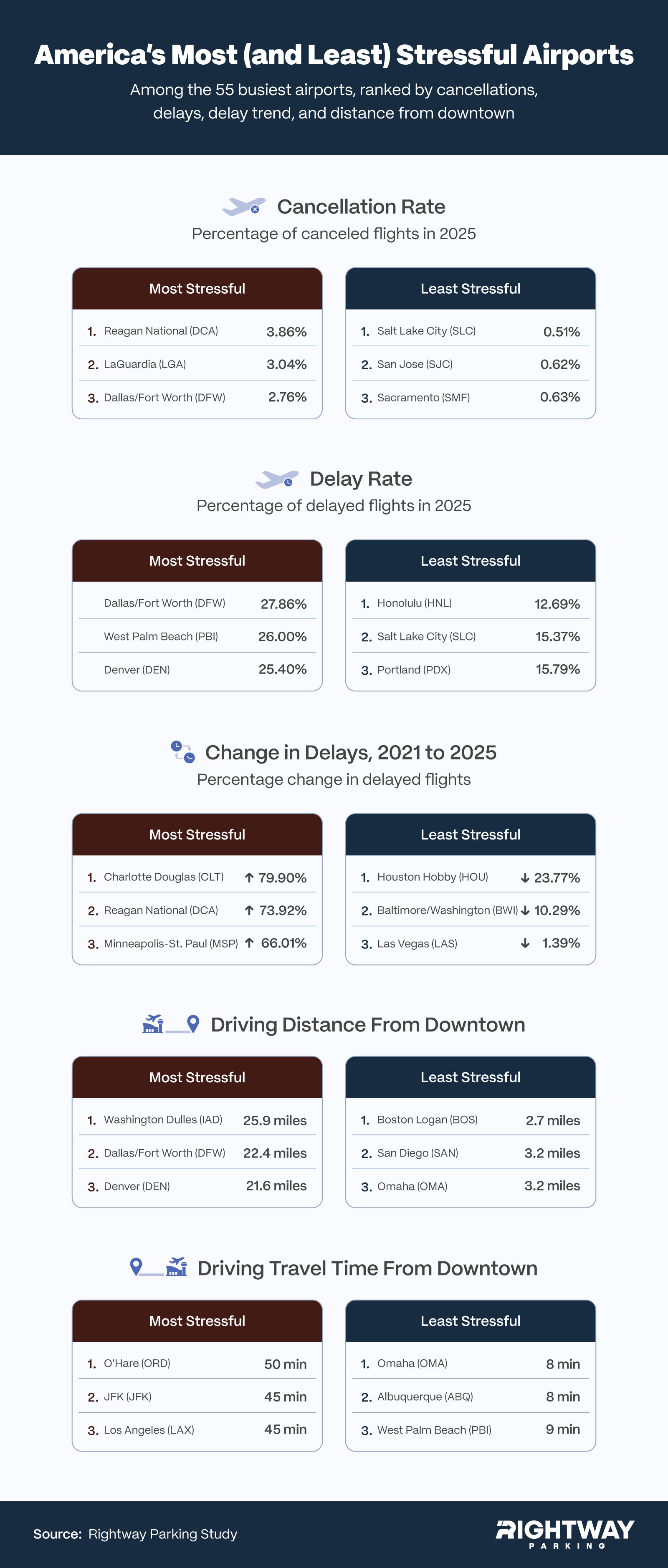
If delays have been your biggest travel headache, Dallas/Fort Worth is one to watch. About 28% of flights are delayed there, followed by West Palm Beach (26.00%) and Denver (25.40%). That works out to roughly 1 in 4 flights leaving late.
Cancellations are a different story. Reagan National has the highest cancellation rate at 3.86%, with LaGuardia at 3.04% and Dallas/Fort Worth at 2.76%. DFW is the only airport to land in the top three for both delays and cancellations.
Some airports are also heading in the wrong direction. Since 2021, delays have jumped 79.90% at Charlotte Douglas, 73.92% at Reagan National, and 66.01% at Minneapolis-St. Paul. Houston Hobby offers a much brighter contrast, with delays down 23.77% over the same period.
Then there's the trip to the terminal itself. Washington Dulles is nearly 26 miles from downtown, while getting to O'Hare from downtown Chicago takes about 50 minutes. On the easier end, Boston Logan is just 2.7 miles from downtown, and travelers can reach Omaha or Albuquerque airports in about 8 minutes.
What This Means for Your Next Trip
None of this means travelers should avoid certain airports altogether, but it does mean padding the schedule at these airports is smart. Building in extra time for the drive, security, and a possible delay can be the difference between a smooth trip and a missed connection, especially at airports where the numbers are trending in the wrong direction.
Methodology
To determine the most and least stressful airports in the U.S., we analyzed the 55 busiest airports using data from the Bureau of Transportation Statistics (BTS) and the Google Maps API. From BTS, we pulled each airport's number of canceled and delayed flights for 2025, and the delay rate from 2021 to 2025 to capture longer-term trends.
From the Google Maps Distance Matrix API, we calculated the driving distance in miles and travel time in minutes from each city to its corresponding airport. Travel time to the airport may vary depending on traffic and time of day; these numbers reflect the time at which the data was collected.
Each of the five metrics was normalized to a 0 to 100 scale and averaged with equal weighting to produce a composite Stress Score for each airport, with higher scores indicating greater travel stress. Airports were then ranked from most to least stressful based on this score.
About Rightway Parking
Rightway Parking makes airport and cruise-port parking cheaper and easier. Through a nationwide network of vetted off-airport lots and partner hotels, Rightway Parking offers reservable, discounted parking at a fraction of typical on-site rates, with shuttle service to the terminal at most locations. For travelers heading to any of the airports in this study, booking a guaranteed spot in advance is one less variable to worry about before a stressful trip even starts.
Fair Use Statement
Feel free to share these findings with others. The data and graphics on this page are free to use for noncommercial purposes. We only ask that you provide attribution to Rightway Parking and a link back to this article so readers can see the full study and methodology.